
The free access to this article was made possible by support from readers like you. Please consider donating any amount to help defray the cost of our operation.
From Edo Gardens to Kankyō Ongaku (Environmental Music): Appreciation of Environmental Sound in Japan
Paul Haimes
In recent years, the work of several artists in the genre of Japanese ambient music—known as kankyō ongaku (environmental music)—has attracted international attention. The works of artists such as Midori Takada and Satoshi Ashikawa, which had been out of print for decades since their initial releases, suddenly found a new audience.[1] Initially, this newfound popularity among electronic and experimental music fans largely was driven by YouTube’s algorithm, but the music has since grown further in popularity, perhaps due to its calming synthetic tones and use of natural environmental sounds throughout.[2] This combination of compositional elements is perhaps best exemplified by Hiroshi Yoshimura’s 1986 album, Green, in which the first track, “Creek,” opens with the sounds of a bubbling, gurgling creek and birdsong before a playfully arpeggiated Yamaha DX7 synthesizer slowly fades in.[3]
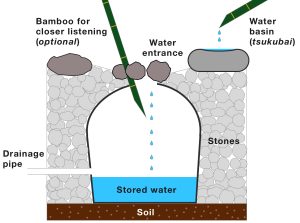
Although these kankyō ongaku artists were heavily inspired by both the ambient music of British musician Brian Eno and the self-described “furniture music” of the French composer Erik Satie (1866-1925) almost a century earlier, a sustained appreciation for environmental sounds by no means is new to a Japanese audience. Some temple gardens—such as the one found at Taizōin within the Zen monastery of Myōshinji in Kyoto—feature underground chambers that echo with the sound of dripping water, known as suikinkutsu. Almost forgotten in contemporary Japan, interest in suikinkutsu reemerged in the second half of the twentieth century, largely due to the research of Katsuzō Hirayama (1899-1990), who documented surviving examples of these Edo-period (1603-1868) devices and provided details of their structure.[4] The suikinkutsu consists of a buried ceramic or metal pot with a small opening at the top, typically situated beside a tsukubai stone water basin. Water drips into the pot, producing soft, resonant echoes, creating a soundscape that blurs the lines between the biophonic (biological sounds) and anthrophonic (human-made sounds).[5] A piece of bamboo may be placed near the opening to invite visitors to listen more closely, a feature more commonly found in modern or restored examples (Figure 1).
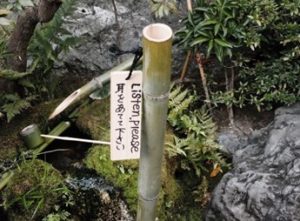
Though water features with auditory elements exist in other cultures, such as the hydraulic organs of Renaissance Europe, there is a lack of comparable examples involving deliberate concealment as a means of subtly inviting the visitor into a state of careful, sustained contemplative listening. The suikinkutsu is something that needs to be experienced to be fully understood: the depth of the buried chamber only becomes apparent after holding your ear closely to the bamboo or the water entrance (Figure 2).
Kankyō ongaku is often (self-)described as background music, but this characterization is a deliberate strategy rather than a limitation. Like the suikinkutsu, it functions on the periphery of environmental perception: sounds that are not attention-seeking, but instead let the nuances become apparent through careful, attentive listening. In both cases, what rewards the listener is not so much the sound itself as the quality of attention its concealment invites. Take it as a humble invitation to pause and listen closely.
Paul Haimes
haimes@fc.ritsumei.ac.jp
Paul Haimes is an artist and designer living in Kyoto, Japan. He is currently a professor of design at Ritsumeikan University. His research interests include design studies, interaction design, Japanese aesthetics, and music applications.
Acknowledgements
The author is grateful for funding from Ritsumeikan University. Thank you also to the anonymous reviewer and Yuriko Saito for their comments and suggestions, and to Machiko Haimes for checking an earlier draft version.
Published on May 23, 2026.
Cite this paper: Paul Haimes, “From Edo Gardens to Kankyō Ongaku (Environmental Music): Appreciation of Environmental Sound in Japan,” Contemporary Aesthetics, Volume 24 (2026), accessed date.
DOI: https://doi.org/10.62729/6a46955b507f7

Endnotes
[1] “The Calming World of Kankyō Ongaku,” Tokyo Weekender, https://www.tokyoweekender.com/entertainment/music/the-calming-world-of-kankyo-ongaku-music/, accessed April 24, 2026.
[2] “Various Artists: Kankyō Ongaku: Japanese Ambient, Environmental & New Age Music 1980-1990,” Pitchfork, https://pitchfork.com/reviews/albums/various-artists-kanky-ongaku-japanese-ambient-environmental-and-new-age-music-1980-1990/, accessed April 25, 2026.
[3] “Green (SFX Version) by Hiroshi Yoshimura,” Bandcamp, https://hiroshiyoshimura.bandcamp.com/album/green-sfx-version, accessed April 27, 2026. When listening to this particular album especially, and perhaps because of the untimely passing of both Yoshimura and his collaborator Ashikawa, I am reminded of Yuriko Saito’s observation that Japanese appreciation of (and sense of unity with) nature is a sensibility grounded in the shared quality of transience. In Yuriko Saito, “The Japanese Appreciation of Nature,” British Journal of Aesthetics, 25, no. 3 (1985): 239-251.
[4] Katsuzō Hirayama, “On the Suikinkutsu of Japanese Garden,” Journal of the Japanese Institute of Landscape Architects, 22, no. 3 (1958): 14-17.
[5] Bryan C. Pijanowski, Luis J. Villanueva-Rivera, Sarah L. Dumyahn, Almo Farina, Bernie L. Krause, Brian M. Napoletano, Stuart H. Gage, and Nadia Pieretti, “Soundscape Ecology: The Science of Sound in the Landscape,” BioScience, 61, no. 3 (2011): 203-216.